
Business
Business
Business
Business
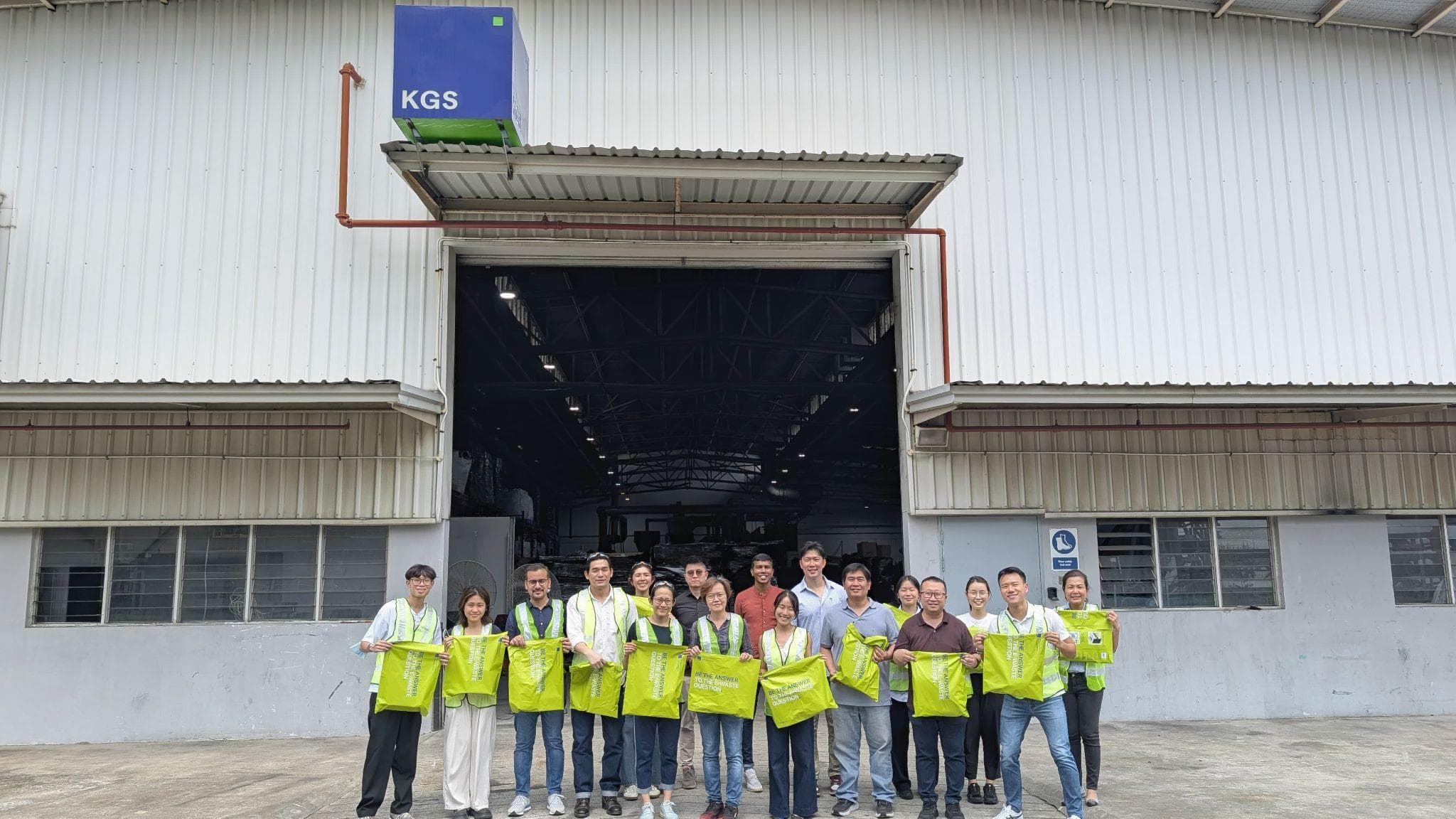
We were honoured to welcome the team from Sembcorp to the KGS facility in Tuas. Here is what they saw, what we discussed, and why conversations like this matter.
When the team from Sembcorp came to visit our facility in Tuas, it was more than a courtesy call. Sembcorp is one of Singapore's leading energy and urban solutions providers, with a long-standing commitment to sustainability and circular economy principles.
Innovation and responsible recycling are not separate goals. They are the same goal approached from different angles.
The visit gave the Sembcorp team a firsthand look at how KGS manages the full spectrum of e-waste recycling at our 32,000 sq ft integrated facility in Tuas. It is, to our knowledge, Singapore's most comprehensive e-waste recycling facility, combining three distinct capabilities under one roof:
General e-waste management: secure, end-to-end processing of electronics from collection through certified data destruction to material recovery, for both businesses and residents
Battery recycling: one of only a handful of dedicated battery recycling facilities in Singapore, with capacity for lithium-ion batteries, adding 2,600 tonnes of annual recycling capacity to Singapore's total
Solar panel recycling: Singapore's first automated solar panel recycling facility, offering certified, NEA-compliant recycling for end-of-life PV modules and related components
As an existing KGS solar panel recycling customer, the Sembcorp team had a particular interest in seeing the facility firsthand and understanding in greater depth how the recycling process actually works.
Singapore's solar energy capacity has grown rapidly, rising from 1.193 GWp in 2023 to 1.573 GWp in 2024, with a national target of at least 2 GWp before 2030. As the island's solar infrastructure continues to expand, a challenge is building quietly in the background: what happens to the panels when they reach end of life?
According to projections, decommissioned solar panels in Singapore are expected to grow from around 134,000 units in 2025 to over 157,000 by 2030. Some panels are being replaced as early as year seven due to faster-than-expected degradation and a lack of local maintenance services. Singapore is expecting approximately 3,500 tonnes of end-of-life solar panels in the next five years alone.
Solar panels are made up of a complex mix of materials: glass, silicon, aluminium frames, and copper wiring. Most of these can be recovered and reused. But separating them requires specialised automated systems and controlled processes. Without proper recycling infrastructure, panels end up in landfill, taking valuable materials with them and creating a new category of waste that undermines the very sustainability goals solar energy is meant to serve.
At the KGS solar panel recycling facility, end-of-life and damaged PV modules go through an automated recycling process that recovers valuable materials including glass, silicon, and aluminium for re-entry into the supply chain. The facility offers a fully managed and compliant solution for solar developers, facilities managers, government agencies, and commercial building owners. KGS is NEA-licensed and compliant with Singapore's regulations, providing tailored solutions for solar farms, rooftops, and commercial arrays.
Under Singapore's Resource Sustainability Act, companies that import and sell solar panels in Singapore are required to provide free take-back services at end of life. KGS is one of the licensed partners equipped to fulfil that responsibility.
Singapore is expecting approximately 3,500 tonnes of end-of-life solar panels in the next five years. The infrastructure to handle them needs to be ready now.
The conversations during the visit ranged across the key questions shaping Singapore's sustainability agenda right now.
On solar panel recycling specifically: how the economics of panel recycling change as volumes scale, what materials recovery rates look like in practice, and how Singapore can position itself as a regional hub for solar panel recycling as ASEAN solar adoption accelerates. The Sembcorp team brought sharp questions from their perspective as an energy company, and the dialogue was genuinely productive.
On innovation more broadly: how technology is changing the economics of recycling across all three streams, from automated processing systems to data-driven operational efficiency. How the cost of responsible recycling comes down as volumes scale, and what that means for Singapore's ability to meet its long-term recycling targets.
On building a sustainable future: what it takes to shift Singapore's recycling culture from one driven by regulation to one driven by genuine understanding of the value at stake. Both organisations share a view that this shift requires collaboration across sectors, not just better infrastructure in isolation.
As covered in our Vulcan Post feature, KGS has been building toward an integrated model since 2016, steadily expanding from a single van and a 600 sq ft unit in Ang Mo Kio into a facility capable of processing 75 tonnes of e-waste per day. That growth has been possible because of the quality of the partnerships built along the way.
When organisations like Sembcorp take the time to visit, ask hard questions, and engage seriously with what KGS is building, it strengthens the broader ecosystem. It creates the conditions for future collaboration, shared standards, and the kind of supply chain connections that make circular economy thinking work in practice rather than just on paper.
Sembcorp's commitment to sustainability and KGS's commitment to being the answer to the e-waste question point in the same direction. We are grateful for the visit and for the conversations that came with it.
Singapore's sustainability agenda is accelerating. The volume of end-of-life electronics, batteries, and solar panels entering the waste stream is growing year on year. Meeting that challenge requires more than individual organisations doing their part. It requires genuine collaboration between companies that understand the problem from different angles and are willing to work together on the solutions.
KGS will continue pushing forward: expanding capacity, building new partnerships, and finding more ways to make responsible recycling the default choice for every organisation and household in Singapore.
Our mission has always been to be the answer to the e-waste question, and to build toward a sustainable tomorrow.
For business e-waste recycling enquiries, reach us at ask@kgs.com.sg. For residents looking to recycle old electronics for free, visit takebag.kgs.com.sg.
See the visit on Instagram: instagram.com/p/DWfplnQk-tw
Sign up for exclusive offers, events and more.