
Business
Business
Business
Business
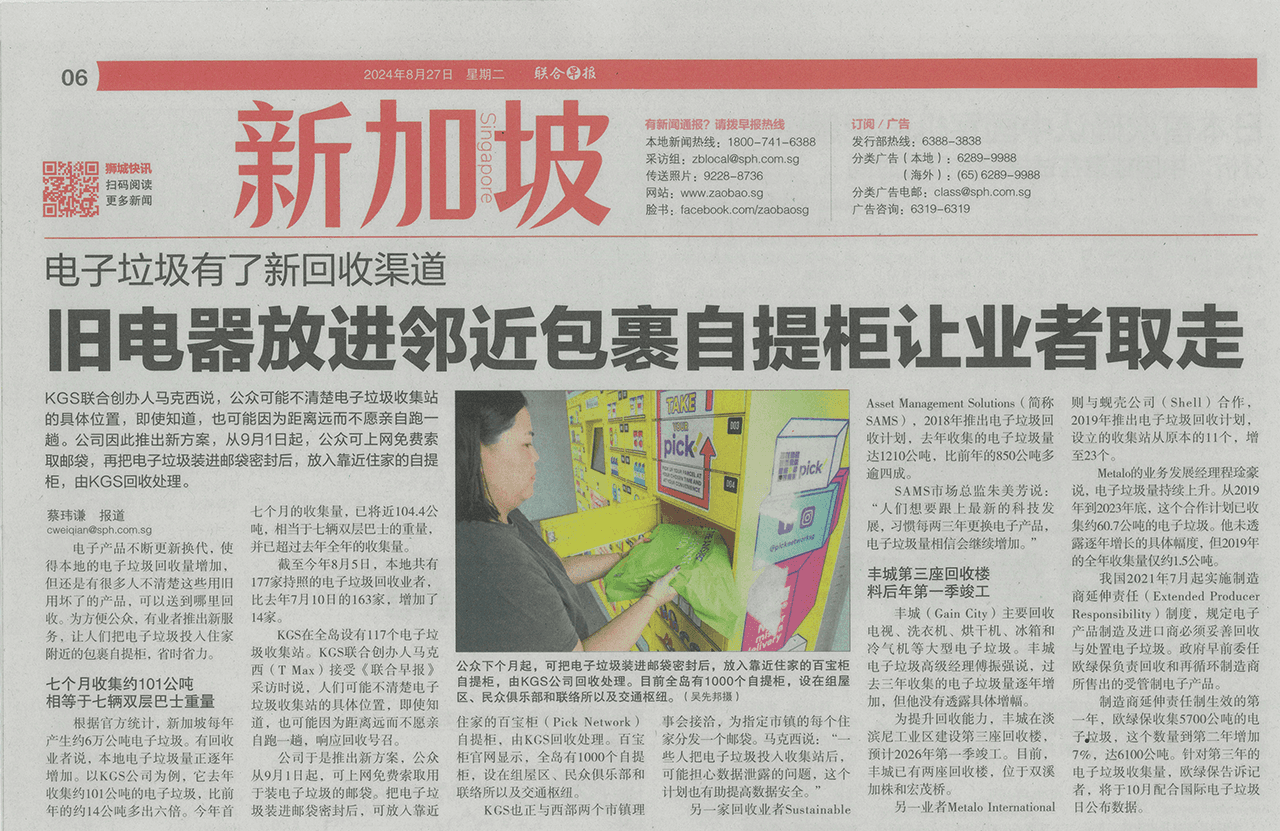
Singapore's most widely read Chinese-language daily covered the TakeBag story in August 2024, highlighting how a simple TakeBag and a nearby PICK! locker is changing the way residents think about recycling their old electronics.
Lianhe Zaobao print article, 27 August 2024
Ask almost anyone in Singapore and they will tell you the same thing. They know they should recycle their old electronics. The intention is there. But when it comes to actually doing it, the question of where and how quickly gets in the way.
Lianhe Zaobao picked up on exactly this tension in their 27 August 2024 feature on TakeBag. The article noted that many residents are simply not clear on where e-waste collection points are, and even when they know, the distance involved can be enough to put them off. Singapore generates around 60,000 tonnes of electronic waste every year, and finding ways to make recycling genuinely accessible to everyday households is one of the more pressing sustainability challenges the country faces. TakeBag is listed on the NEA's official e-waste recycling page as a direct response to that challenge.
Many residents are not clear on where e-waste collection points are, and even when they know, the distance can be enough to put them off.
The concept behind TakeBag is straightforward. Residents order a free TakeBag from takebag.kgs.com.sg. It arrives at their door. They fill it with old electronics at home — phones, laptops, tablets, cables, chargers, power banks — and when they are ready, they scan the QR code inside the bag to book a slot at their nearest PICK! locker.
There are around 1,000 PICK! locker locations spread across Singapore's HDB estates, community clubs, MRT stations and other accessible locations. For most residents, that means a drop-off point within roughly 5 minutes of home. The drop-off itself takes under 2 minutes. The bag goes in, the locker closes, and KGS collects it from there.
From that point, every item in the bag is handled at KGS's facility in Tuas. Data-bearing devices undergo certified data destruction before anything else is done. Then the electronics are assessed for reuse or responsibly recycled, with materials separated and processed correctly.
The Zaobao article reported that in the seven months leading up to publication, KGS had collected 101 kg of e-waste through the TakeBag programme. To put that in perspective, the article compared it to the weight of seven double-decker buses. For a programme in its early stages, built entirely around voluntary household participation, that figure reflects a strong level of community take-up.
It is also worth noting that these numbers represent devices that did not end up in general waste bins, did not risk leaching toxic materials into the environment, and did not pose the fire hazards that lithium-ion batteries can create when disposed of incorrectly.
101 kg of e-waste collected in seven months. Every kilogram a device that did not end up in a bin.
One aspect of TakeBag that the Zaobao article specifically drew attention to was data security. For many residents, the concern about recycling a phone or laptop is not just environmental. It is personal. What happens to the photos, messages, banking information, and other data stored on a device once it leaves your hands?
TakeBag addresses this directly. Every data-bearing device processed by KGS undergoes certified data destruction, using degaussing, physical shredding, or secure overwriting depending on the device type. These are professional-grade methods, the same standards applied to enterprise IT equipment. For residents recycling personal devices, that assurance matters.
Being featured in Lianhe Zaobao carries particular significance. As Singapore's most widely read Chinese-language daily, Zaobao reaches a large segment of the resident population who may not engage with English-language coverage of environmental programmes. The feature helped introduce TakeBag to a broader audience and reinforced that responsible e-waste recycling is something every household in Singapore can participate in, regardless of background.
TakeBag has also been featured on Channel 8, is listed on Recyclopedia.sg as one of Singapore's most accessible recycling options, and is recognised by the NEA as part of the national e-waste recycling effort.
If you have old electronics sitting at home, the message from the Zaobao feature is simple: you now have a free, convenient, and responsible way to recycle them. The bag comes to you. The drop-off is nearby. And your data is properly handled along the way.
Order your free TakeBag at takebag.kgs.com.sg. If you have questions, reach out to the team at ask@kgs.com.sg.
Sign up for exclusive offers, events and more.