
Business
Business
Business
Business
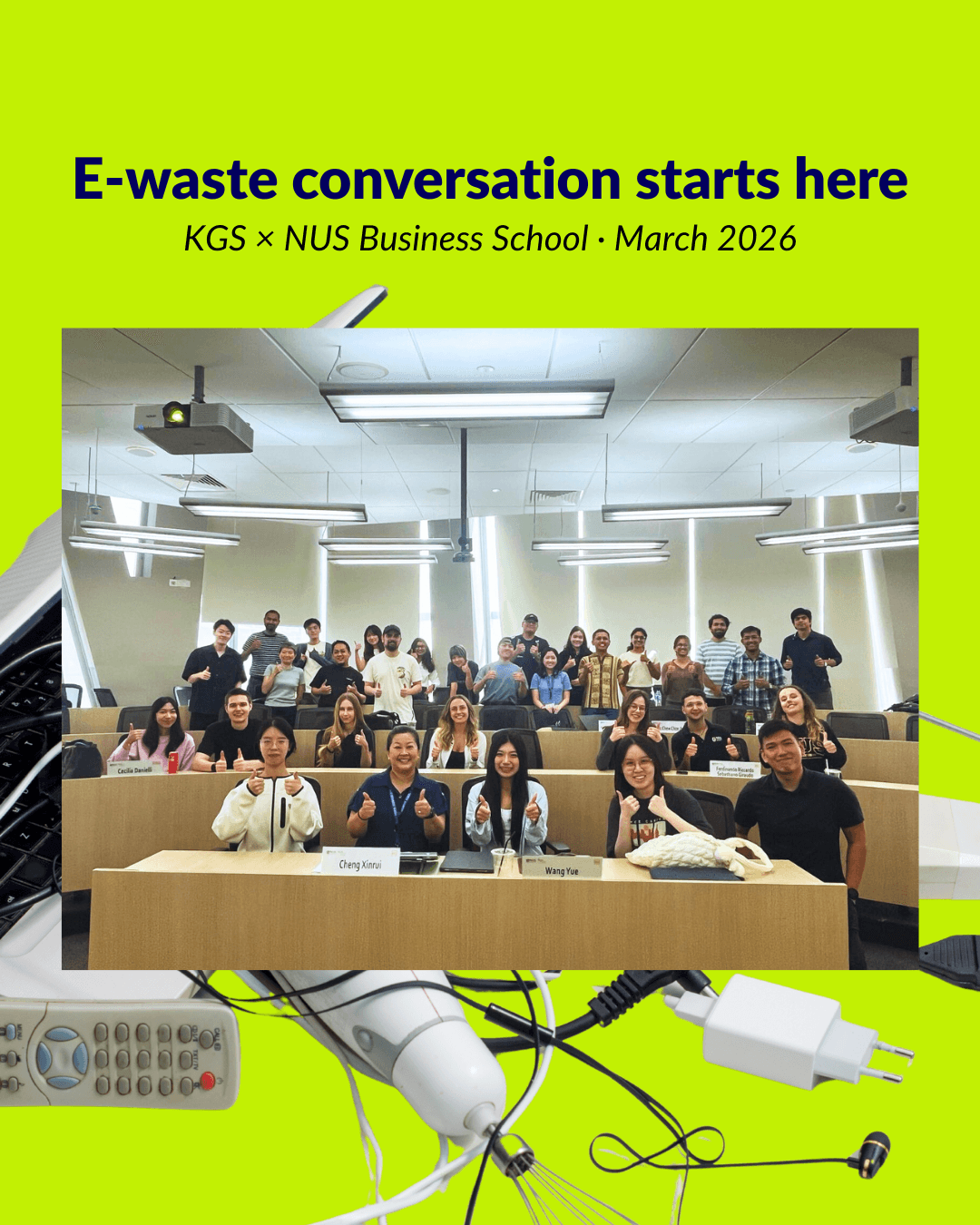
Last week, the KGS team had the opportunity to speak at NUS Business School and it turned out to be one of the most energising sessions we have had in a long time.
We walked in prepared to teach. We walked out reminded of why we do what we do.
Electronic waste is one of the fastest-growing waste streams in the world. Globally, tens of millions of tonnes of discarded electronics are generated every year, and only a fraction of that is recycled responsibly.
In Singapore, the challenge is no different. The country generates approximately 60,000 tonnes of e-waste every year, with a recycling rate of around 5.5%, as reported by Vulcan Post in a feature on KGS. Old phones, laptops, chargers, and cables pile up in drawers, storerooms, and eventually general waste bins, where the toxic materials inside them, lead, mercury, and cadmium, risk leaching into the environment and causing lasting harm.
The problem is not a lack of care. Most people want to do the right thing. The barrier is a combination of awareness and convenience. People do not always know where to bring their e-waste, or do not realise how straightforward responsible recycling can be. That is the gap KGS is working to close.
Singapore generates approximately 60,000 tonnes of e-waste every year. Only around 5.5% of that is properly recycled.
When Dr Janet from NUS Business School extended the invitation to share our work, we jumped at it. University students are not just the next generation of consumers. They are future decision-makers, business leaders, and sustainability advocates. Getting them thinking seriously about e-waste early matters.
During the session, we covered the scale of Singapore's e-waste problem, the environmental and health consequences of improper disposal, and how KGS is making recycling accessible through programmes designed for everyday residents and organisations alike.
A significant part of the conversation focused on TakeBag, KGS's free e-waste recycling programme for Singapore residents. Rather than asking people to find a drop-off point, TakeBag delivers a free polymailer bag to your door. You fill it with old electronics at home and drop it off at any of approximately 1,100 PICK! locker locations across Singapore, most within 5 minutes of any HDB home.
Here is what we did not fully anticipate: how much we would learn in return.
The questions from the room were genuinely impressive. Students asked about:
The lifecycle of recycled materials: what happens after a device is processed, and how recovered metals and plastics re-enter the supply chain
The economics of e-waste recycling: how recyclers generate revenue from materials recovery, and what makes the business model sustainable
Data destruction: how KGS verifies that personal and corporate data on devices is permanently and securely destroyed before recycling begins
Dumpster diving for e-waste: the risks around discarded data-bearing devices such as phones, laptops, and hard drives being retrieved from general waste bins, and how the personal and corporate data still stored on them puts people at serious risk
On that last point, the conversation got particularly lively. When a phone or laptop ends up in a general waste bin, it rarely gets there empty. Most discarded devices still contain personal photos, banking apps, saved passwords, work emails, and contact lists. People assume that because a device is old or broken, it is harmless. But data does not disappear on its own.
Dumpster diving for discarded electronics is more common than most people realise. Devices retrieved from bins can be powered on, accessed, or stripped for storage components, all without the original owner ever knowing. Without certified data destruction, there is no way to guarantee that what was on a device stays private after it leaves your hands.
This is one of the reasons KGS treats data destruction as a non-negotiable part of the recycling process. Every data-bearing device collected through TakeBag undergoes certified destruction before anything else happens, giving residents genuine peace of mind that their information will not end up in the wrong hands.
These were not surface-level questions. They were the kind that push a company to think harder about what it does and how it explains it. And for us, that was the most valuable part of the morning.
The questions were not surface-level. They were the kind that push a company to think harder about what it does and why.
One of the most common questions we hear, both from students and the general public, is: how do I actually recycle my old electronics in Singapore? Here is the simplest answer we have.
If you are a Singapore resident, the easiest option is TakeBag:
Visit takebag.kgs.com.sg and order your free polymailer bag
Wait for it to arrive at your door, at no cost
Fill it with old electronics: phones, laptops, tablets, cables, chargers, power banks, and more
Scan the QR code inside to book a slot at your nearest PICK! locker
Drop it off within a one-week window. The whole drop-off takes under 2 minutes
KGS handles certified data destruction and responsible recycling from there
TakeBag is listed on the NEA's official e-waste recycling page as a recognised programme for Singapore residents, and has been featured on Channel 8 and in Lianhe Zaobao.
Recycling infrastructure matters. Convenient drop-off points matter. Responsible processing matters. But none of it works at scale without awareness. People recycle when they understand why it matters and when doing so feels straightforward.
KGS's community engagement extends beyond talks. From distributing TakeBags door-to-door across Singapore estates including Zhenghua and Clementi, to participating in AlterCOP30, to launching the #PressReset Challenge, the goal is always the same: make the right choice the easy choice.
Awareness and convenience together are what turn good intentions into actual recycling.
A genuine thank you to Dr Janet and NUS Business School for the warm welcome and the platform to share what we do.
Our mission has always been to be the answer to the e-waste question. A sustainable tomorrow, one device at a time.
Ready to start recycling your e-waste? Visit takebag.kgs.com.sg to order your free TakeBag and join the movement.
Sign up for exclusive offers, events and more.